Lately, I have been thinking about the idea of brain scaffolding.
Scaffolding is the temporary framework placed around a building while it is being repaired, strengthened, or expanded. When we use the term in relation to the brain, it offers a hopeful way to think about aging.
Our brains change throughout life. Some kinds of recall or mental speed may become less immediate as we grow older. During perimenopause and menopause, many women also describe difficulty concentrating, disrupted sleep, forgetfulness, or the feeling that familiar words are temporarily out of reach.
These experiences can be unsettling, especially in a culture that tends to describe aging almost entirely as loss.
But change is not the same as disappearance.
The brain has a continuing ability to adapt. It can strengthen connections, recruit other pathways, and draw upon everything we have learned through experience. Brain scaffolding is one way of describing this capacity to build support around the changes that occur over time.
I find this idea meaningful because it shifts the question.
Instead of asking only, ‘What am I losing?’ we can also ask, ‘What am I building?’
We build scaffolding when we learn something unfamiliar, solve a problem, have a meaningful conversation, move our bodies, practice balance, make music, read, create, teach, or participate in community.
We also support the brain by caring for the body that carries it.
Movement, sleep, cardiovascular health, nourishing food, social connection, stress support, and attention to hearing and vision are not glamorous shortcuts. They are ordinary practices that matter over time.
There is no single yoga pose, breathing exercise, supplement, or wellness program that can guarantee protection from dementia. I think it is important to say that clearly.
Brain health is complex. Genetics, medical conditions, environment, access to healthcare, and many other influences are involved. Concerns about memory or significant changes in thinking deserve conversation with a qualified medical professional.
But the absence of a guarantee does not mean that our daily choices are meaningless.
In my work, I am interested in practices that help people stay engaged with their bodies, their relationships, their curiosity, and their sense of possibility.
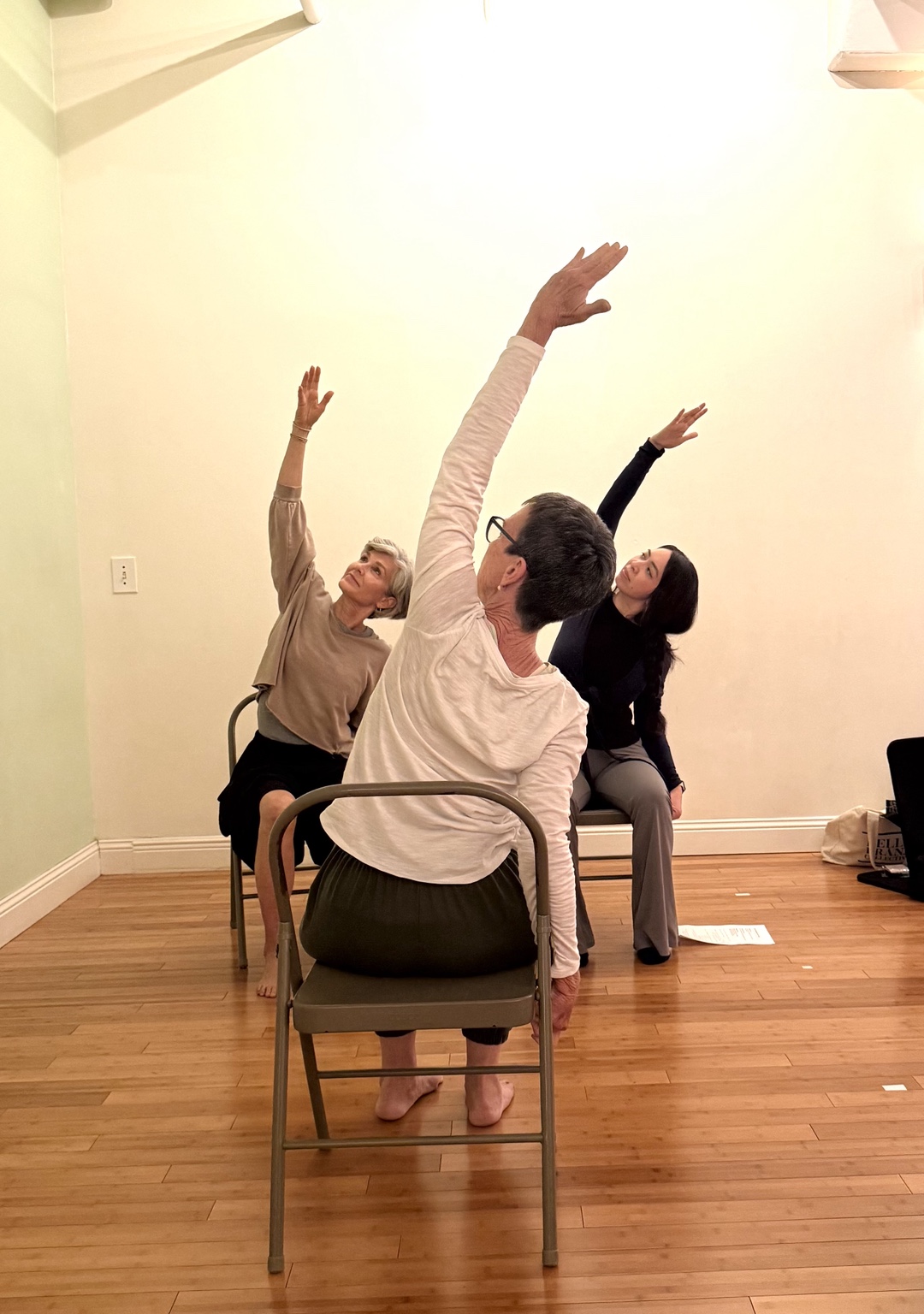
Yoga can ask the brain and body to communicate in interesting ways. We move one side and then the other. We shift our weight. We coordinate movement with breath. We practice balance, learn sequences, and pay attention to where we are in space.
The goal is not to make the movement complicated simply for the sake of difficulty. Challenge needs to be appropriate. It should invite attention without creating fear, pain, or overwhelm.
Rest matters too.
A nervous system that is constantly strained does not necessarily need another demanding task. Sometimes the supportive practice is restorative yoga, yoga nidra, a walk outside, a quieter evening, or receiving help with something we have been carrying alone.
Midlife often arrives with many overlapping demands. We may be working, raising or supporting children, caring for parents, navigating menopause, managing changing relationships, and reconsidering what we want from the next part of life.
It is understandable that our minds sometimes feel full.
That is why brain scaffolding is not only about crossword puzzles or memory exercises. It is about creating a life that continues to offer movement, purpose, learning, recovery, relationship, and meaningful participation.
Our experience is also part of the scaffolding.
As we age, we develop context. We recognize patterns. We understand that life can contain more than one truth at a time. We may not always retrieve information as quickly as we once did, but we often have a deeper well from which to understand it.
Wisdom cannot always be measured by speed.
For me, building brain scaffolding means staying involved in my own life. I want to remain curious without demanding perfection, learn new things while honoring what I already know, care for my physical health, make room for rest, and stay connected to other people.
Most importantly, I refuse the idea that aging makes us less relevant.
Aging does not end our capacity to learn, adapt, contribute, or become.
Each time we participate in that process with intention, we add another piece of scaffolding.